
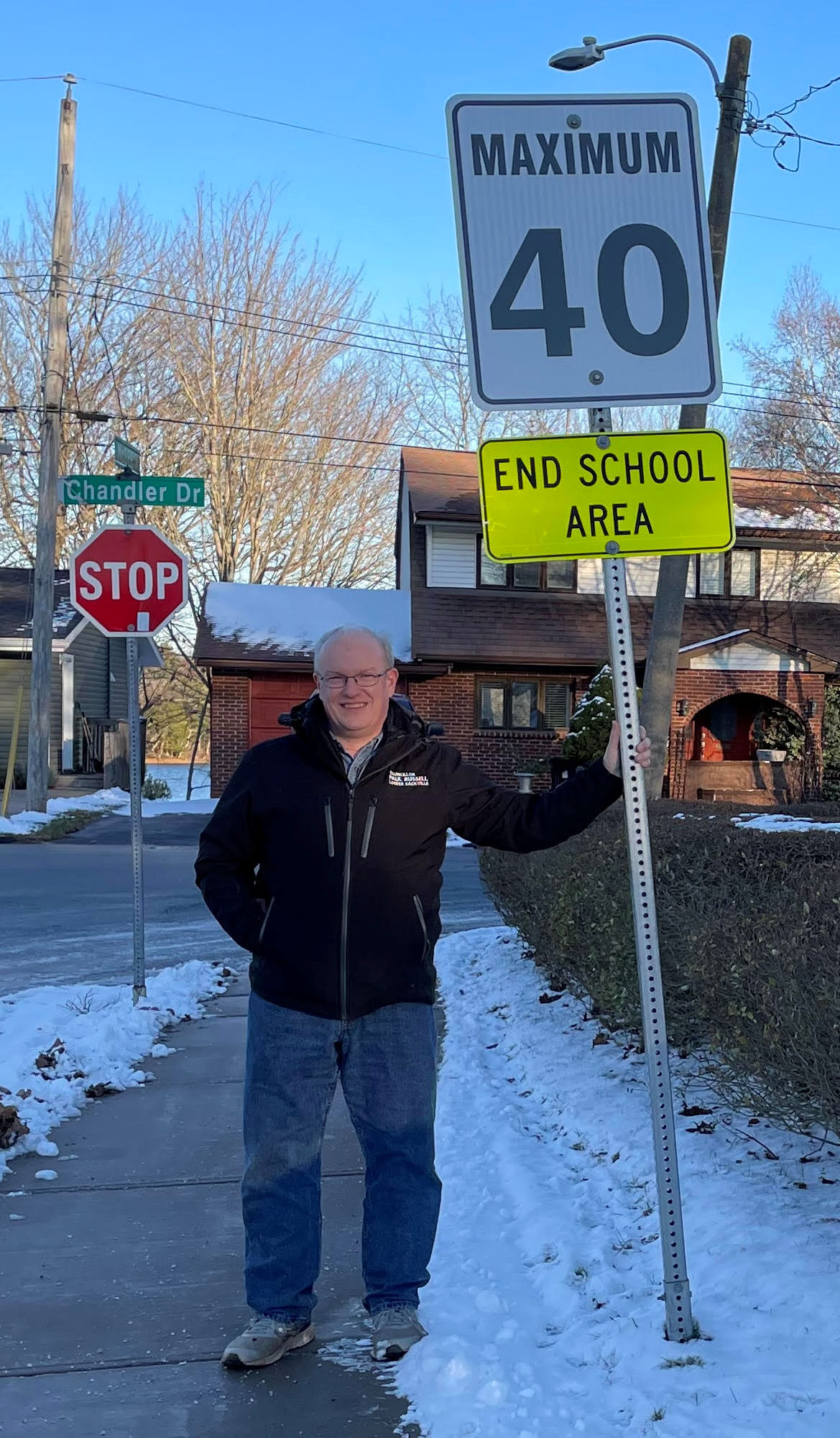
 Over the years we have heard of people speeding all over Lower Sackville. Speed on neighbourhood streets was the number one issue that I heard on the doorsteps, by far. This is what prompted me to get the portable speed radar and deploy it around Lower Sackville and also work to get the speeds lowered in school zones.
Sometimes people speed because they think it is fun, or they are intoxicated, or they are late, and sometimes it is an innocent mistake and they don’t realize it. But what are the effects of driving too quickly?
Let’s look at some of the results of driving faster than you should.
Driving faster is not safe
In all cases, driving faster than the law allows or driving faster than the conditions allow is not safe. We see report after report that shows the same things:
- the faster you drive, the more stopping distance is needed; and
- the faster you drive, the higher the chance of serious injury or death if you hit someone
Your stopping time is your reaction time plus the stopping distance. As you drive faster, both of those times increase. If you need to stop quickly then your chances of doing that drops significantly when you drive faster.
The chart below is from the city of Edmonton, based on data from the WHO. The original source is here: https://www.edmonton.ca/sites/default/files/public-files/202201_Stopping-Distance-Increasing-Braking-Distance_VisionZero.pdf
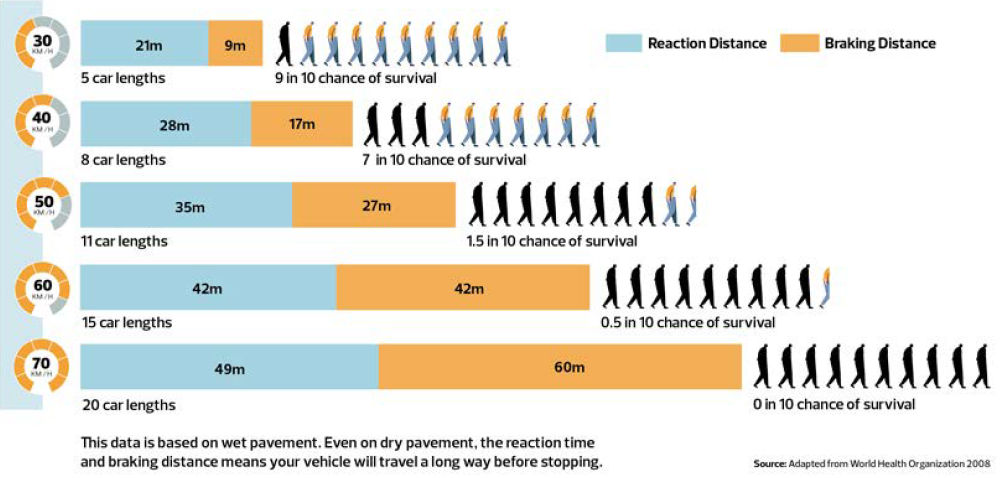
If you hit someone at 40kmh then they have a 70% chance of survival. If you hit someone at 50kmh then that drops to 15%.
Another way to look at this is to assume that someone is a certain distance away when you first see them, and then you try to stop. The chart below is from https://www.edwardtufte.com/notebook/auto-safety-stopping-distance-chart/ and shows how fast you would be going if you hit someone.
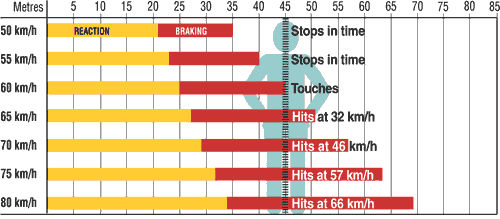
For a full review of this please refer to: https://www.fhwa.dot.gov/publications/research/safety/98154/speed.cfm
Driving faster uses more fuel
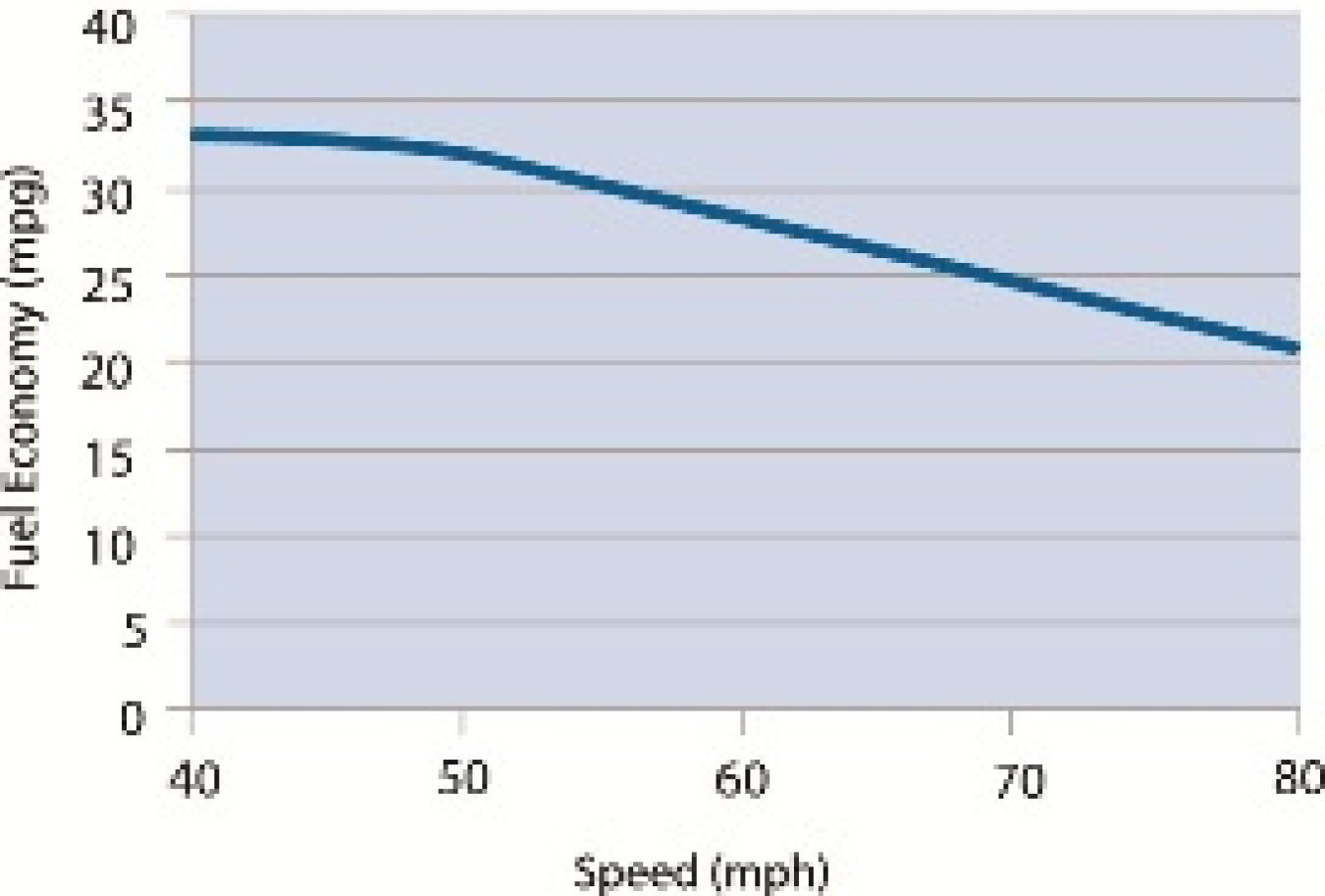 And the faster you drive the more energy you use. The Government of Canada talks about this here: https://natural-resources.canada.ca/energy-efficiency/transportation-energy-efficiency/personal-vehicles/fuel-efficient-driving-techniques and the US Department of Energy shows that here: https://www.energy.gov/energysaver/fuel-economy with more information here: https://www.energy.gov/energysaver/driving-more-efficiently and has a toolbox to help explain that here: https://cleancities.energy.gov/technical-assistance/idlebox
They show that aggressive driving can lower your highway gas mileage by 15% to 30% and your city mileage by 10% to 40%.
Other studies, from around the world, show the same thing. This report, from Australia, cites (and links to) a New Zealand study which concludes that driving faster does use more fuel: https://www.drive.com.au/caradvice/do-you-use-more-fuel-at-higher-speeds/
Driving faster doesn’t save much time
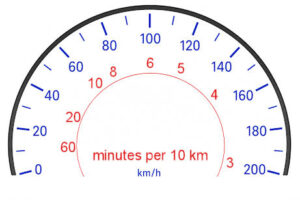 So does driving faster get you to your destination sooner? Yes, but not by much.
We normally measure speed as kilometers per hour. What if we flip that equation to be minutes per kilometer?
The image on the right shows the number of minutes that you travel at different speeds. When you are driving below 60 kmh it makes a big difference. Above that, however, the time difference drops very quickly. At 75 kmh it takes you 8 minutes to drive 10 km, and 100 km it drops to 6 minutes.
As you drive faster you do not save much time.
The difference in fuel consumption, stopping distance, and survival rates, however, change dramatically.
Conclusion: Please slow down and drive defensively
There is a lot that goes in to why people drive fast. Some reasons were mentioned above, and sometimes it is the result of straight wide roads, which give a false sense of safety. In all cases driving safely is our responsibility, and driving at the right speed for the law and for the conditions is the safest.
Additionally, we all know that anything can change at any time, and it’s best to drive as if you will have to stop, especially in our neighbourhoods. We all want to be safe, both walking and driving.
Please slow down, please drive the limit and for the conditions, and please drive defensively.
The following table was used to generate the speedometer image. Feel free to confirm it.
| km / h | min / km | min / 10 km |
|---|---|---|
| 10 | 6 | 60 |
| 15 | 4 | 40 |
| 20 | 3 | 30 |
| 30 | 2 | 20 |
| 40 | 1.5 | 15 |
| 60 | 1 | 10 |
| 75 | 0.8 | 8 |
| 100 | 0.6 | 6 |
| 120 | 0.5 | 5 |
| 150 | 0.4 | 4 |
| 200 | 0.3 | 3 |